
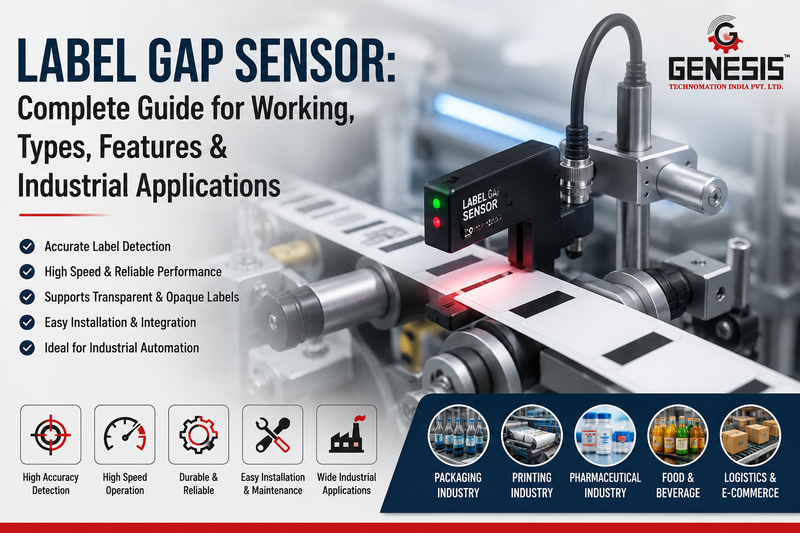
Label Gap Sensor: Complete Guide to Working, Uses & Selection
Modern labeling systems depend on speed, accuracy, and consistency. Whether labels are applied to bottles, cartons, pharmaceutical products, food packages, or industrial components, the machine must know exactly where one label ends and the next begins. This is where a Label Gap Sensor becomes an essential part of the labeling process. A properly selected sensor helps detect the gap between consecutive labels, synchronize dispensing, and ensure that every label is applied at the correct position.
Although a label sensor may appear to be a small component, its role is much bigger than its size suggests. A poor sensor choice can lead to missed labels, incorrect positioning, machine stoppages, wasted material, and reduced production efficiency. On the other hand, the right sensor can support high-speed labeling with dependable detection across a wide range of label materials.
This complete guide explains what a Label Gap Sensor is, how it works, where it is used, the different types available, and how to select the right sensor for your application.
What Is a Label Gap Sensor?
A Label Gap Sensor is a sensing device used in labeling machines to detect the spaces or gaps between individual labels on a continuous backing material, also known as a label web. The sensor helps the labeling machine determine the exact position of each label before dispensing or applying it to a product.
In a typical label roll, multiple labels are placed on a liner or backing paper with small gaps between them. The sensor identifies these gaps by detecting differences in thickness, light transmission, reflection, or material properties. Once the gap is detected, the labeling system can stop, start, or adjust the movement of the label web.
The basic purpose is simple: detect where one label ends and the next begins.
However, achieving reliable detection is not always simple. Labels can be transparent, highly reflective, metallic, dark-colored, extremely thin, or irregularly shaped. The backing material can also vary in thickness and transparency. These factors make sensor selection an important engineering decision.
Why Is Label Gap Detection Important?
Accurate gap detection is essential for maintaining the timing and precision of an automated labeling system.
Imagine a high-speed packaging line applying hundreds of labels every minute. If the sensor fails to detect a gap correctly, the machine may release the next label too early or too late. The result could be a crooked label, a missing label, two labels applied together, or a production stoppage.
Reliable label detection helps manufacturers achieve:
- Accurate label positioning
- Consistent product appearance
- Reduced material waste
- Higher machine speeds
- Fewer production interruptions
- Better synchronization between machine components
- Improved quality control
- Reduced operator intervention
For industries where label placement carries regulatory importance, such as pharmaceuticals and food manufacturing, accurate sensing becomes even more critical.
How Does a Label Gap Sensor Work?
The working principle depends on the type of sensor being used, but most Label Gap Sensors compare the physical or optical characteristics of the label area with the gap area.
As the label web moves through the sensor, the device continuously monitors the material passing through its sensing zone.
When a label is present, the sensor receives one type of signal.
When the gap appears, the signal changes.
The sensor’s electronics interpret this change and send an output signal to the labeling machine. The machine then uses this information to control label movement or dispensing.
A simplified working process looks like this:
- The label roll feeds through the labeling machine.
- The label web passes through the sensor.
- The sensor detects the difference between the label and the gap.
- An electrical output signal is generated.
- The machine controller receives the signal.
- The label feed is adjusted or stopped at the required position.
- The label is peeled, dispensed, or applied accurately.
This process happens extremely quickly. In high-speed industrial applications, the sensor must detect very small gaps while maintaining reliable performance over thousands or even millions of labeling cycles.
Main Components of a Label Gap Sensor System
While the exact design varies by manufacturer, a typical sensor system may include several important elements.
1. Sensing Element
The sensing element is responsible for detecting the difference between the label and the backing material. Depending on the sensor technology, this may involve light transmission, reflection, capacitance, or another detection principle.
2. Light Source
Optical sensors often use an internal light source. This may include LED-based illumination or other optical technology designed to provide stable detection.
3. Receiver
The receiver detects the light that passes through or reflects from the material. It converts the received signal into electrical information.
4. Signal Processing Circuit
The sensor electronics analyze the difference between the label area and the gap. Modern sensors can automatically adjust sensitivity and compensate for changing materials.
5. Output Interface
Once the sensor detects a label or gap, it sends a signal to the machine control system. Common industrial output options may include PNP, NPN, analog, or digital switching outputs.
6. Adjustment Controls
Some sensors include manual adjustment controls, while more advanced models may offer automatic teach-in functions.
Types of Label Gap Sensors
Different applications require different sensing technologies. Understanding the major sensor types can make the selection process easier.
Through-Beam Label Gap Sensors
Through-beam sensors are among the most commonly used technologies for label detection. The system measures how much light passes through the label web.
A light source is positioned on one side of the material, while a receiver is located on the opposite side. When the backing material or gap passes through the sensing area, more or less light may reach the receiver than when a label passes through.
The sensor uses this difference to identify the label gap.
Advantages include:
- High detection accuracy
- Fast response times
- Reliable operation in many labeling applications
- Suitable for high-speed machines
These sensors are particularly useful when the optical properties of the label and backing material provide sufficient contrast.
Ultrasonic Label Sensors
Ultrasonic sensors use sound waves rather than visible light to distinguish between the label and the backing material.
This technology is particularly valuable when optical sensors struggle with transparent or highly reflective labels. Since ultrasonic sensing detects differences in material structure and thickness, it can often work with materials that create very little optical contrast.
Ultrasonic sensors are commonly used for:
- Transparent labels
- Clear films
- Reflective materials
- Difficult optical applications
One major advantage is that the sensor does not rely solely on color contrast. A clear label on a clear backing can still be detected if the material structure produces a measurable ultrasonic difference.
Capacitive Sensors
Capacitive sensing technology detects changes in electrical capacitance caused by differences between materials.
In some specialized applications, capacitive sensors may be used to distinguish labels from backing material based on thickness or dielectric properties.
Their effectiveness depends heavily on the materials involved, environmental conditions, and sensor configuration.
Optical Contrast Sensors
Optical contrast sensors identify differences in reflected light between the label and the background or backing material.
These sensors can be effective when labels have clear visual contrast, but performance may be affected by changing colors, glossy surfaces, printed patterns, or transparent materials.
They are often used in applications where a visible mark, edge, or contrast difference can provide a reliable detection point.
The Role of Fork Sensors in Label Detection
Fork sensors are widely used in compact and high-speed detection applications because they combine the emitter and receiver inside a U-shaped housing. The label web passes through the opening, or fork, between the two sensing elements.
This design offers several practical advantages. Alignment is easier because the transmitter and receiver are already fixed in the correct position. The compact structure also allows the sensor to be installed in machines where space is limited.
Fork sensors are commonly used for detecting:
- Labels and label gaps
- Tags
- Small parts
- Paper edges
- Packaging materials
- Registration marks
In labeling equipment, a fork-style design can provide stable detection because the sensing path is mechanically defined. The material simply passes through the gap in the sensor.
However, the correct fork width, sensing technology, response speed, and material compatibility should still be evaluated before selection.
Common Uses of Label Gap Sensors
Label Gap Sensors are used across a broad range of industries and automation systems.
Packaging Industry
Packaging machines frequently use these sensors to control the dispensing of product labels.
Applications include:
- Food containers
- Beverage bottles
- Cosmetic packaging
- Household products
- Consumer goods
The sensor ensures that each package receives a label at the correct time and position.
Pharmaceutical Manufacturing
Pharmaceutical labeling requires a high level of accuracy. Labels may contain dosage information, batch details, regulatory markings, barcodes, or tracking data.
A missed or incorrectly placed label can create serious quality and compliance issues.
Sensors are therefore used in:
- Medicine bottle labeling
- Blister packaging
- Vial labeling
- Syringe labeling
- Carton labeling
Food and Beverage Production
Food and beverage facilities often operate at high production speeds. Label sensors help synchronize labeling systems for bottles, jars, cans, pouches, and other containers.
Because these environments may include moisture, dust, vibration, and frequent cleaning, sensor durability is also important.
Logistics and Warehousing
Labels play a major role in identification, tracking, and shipping. Automated printing and application systems use sensors to detect label positions before applying shipping or inventory labels.
Electronics and Industrial Manufacturing
Small identification labels are commonly applied to electronic components, cables, industrial parts, and equipment.
These applications may require extremely precise gap detection, particularly when labels are small and closely spaced.
Factors That Affect Sensor Performance
Several variables can influence the reliability of a Label Gap Sensor.
Label Material
Paper labels, plastic films, transparent materials, metallic labels, and coated surfaces may behave differently during detection.
A sensor that works perfectly with paper labels may not work reliably with clear plastic film.
Label Thickness
The thickness difference between the label and backing material can affect detection. Ultrasonic and capacitive technologies may perform differently depending on this characteristic.
Backing Material
The liner can be paper, film, transparent plastic, or another material. Its optical and physical properties directly influence sensor selection.
Gap Size
Small gaps are more difficult to detect than larger ones. High-precision applications may require a sensor capable of reliably recognizing very narrow spaces.
Machine Speed
As label speed increases, sensor response time becomes more important.
A slow sensor may detect the gap after it has already passed the required position.
Environmental Conditions
Dust, moisture, temperature changes, vibration, and contamination can affect sensor performance.
Industrial environments should be considered during the selection process.
How to Choose the Right Label Gap Sensor
Choosing the right sensor should begin with the application rather than the product catalog.
Here are the most important selection criteria.
1. Identify the Label Material
Determine whether the labels are:
- Paper
- Plastic
- Transparent film
- Metallic
- Reflective
- Printed
- Highly glossy
This information immediately helps narrow the available sensing technologies.
2. Check the Backing Material
The backing liner is just as important as the label itself.
For example, transparent labels on transparent backing may create significant challenges for traditional optical sensing. In such cases, ultrasonic sensing may be more suitable.
3. Measure the Gap
Identify the minimum distance between labels.
The sensor should be capable of detecting the smallest expected gap with a reasonable margin for reliable operation.
4. Consider Production Speed
High-speed labelers require fast response times and stable signal processing.
Always review the maximum switching frequency and response specifications relative to the actual web speed.
5. Evaluate Installation Space
Some machines have very limited mounting space. Compact sensor designs or fork-style configurations may be better suited to these environments.
6. Consider Setup and Adjustment
Modern sensors may offer:
- Manual sensitivity adjustment
- Push-button teach-in
- Automatic calibration
- Remote configuration
- Digital displays
Automatic setup features can reduce installation time and make product changeovers easier.
7. Review Output Compatibility
The sensor must communicate properly with the existing control system.
Check compatibility with:
- PLC inputs
- PNP outputs
- NPN outputs
- Industrial controllers
- Machine interface requirements
8. Consider Environmental Protection
Choose an appropriate protection rating for the operating environment.
Dusty, wet, or washdown environments may require more durable sensor housings and higher ingress protection.
Installation Tips for Better Performance
Even the best sensor can produce poor results if installed incorrectly.
Follow these general practices:
- Mount the sensor securely to minimize vibration.
- Ensure the label web passes correctly through the sensing area.
- Avoid excessive material movement.
- Keep the sensing surface clean.
- Follow the manufacturer’s recommended orientation.
- Perform calibration using the actual production material.
- Test the sensor at normal operating speed.
It is also important to test multiple points on a label roll. Material properties may vary slightly from one section of the roll to another.
Common Problems and Troubleshooting
Sensor Does Not Detect the Gap
Possible causes include:
- Incorrect sensitivity settings
- Wrong sensor technology
- Transparent or reflective label material
- Dirty sensing surfaces
- Improper installation
Try recalibrating the sensor and checking whether the selected sensing technology is suitable for the label material.
False Detection
False signals can occur because of:
- Printed graphics
- Surface reflections
- Material vibration
- Dust or contamination
- Poorly adjusted sensitivity
Proper sensor positioning and calibration can often solve the issue.
Inconsistent Detection at High Speed
This may result from:
- Slow sensor response
- Excessive web movement
- Mechanical vibration
- Insufficient gap size
- Control system timing problems
The entire system should be evaluated rather than focusing only on the sensor.
Difficulty With Transparent Labels
Transparent labels are a common challenge for optical sensors.
An ultrasonic Label Gap Sensor may provide more reliable detection in applications where light-based sensing cannot distinguish clearly between the label and liner.
Benefits of Using the Right Sensor
Selecting the correct sensor can improve both quality and operational efficiency.
The main benefits include:
- More accurate label placement
- Faster production speeds
- Reduced machine downtime
- Lower label waste
- Easier product changeovers
- Improved automation reliability
- Better product presentation
- Reduced manual inspection
Over time, a reliable sensing solution can also reduce maintenance costs and prevent repeated troubleshooting.
Future Trends in Label Sensing Technology
Sensor technology continues to evolve as labeling machines become faster and more automated.
Future systems are increasingly focused on:
- Automatic calibration
- Smart diagnostics
- Improved transparent material detection
- Smaller sensor designs
- Digital communication
- Remote monitoring
- Faster response times
Modern industrial sensors may also provide diagnostic information that helps operators identify contamination, alignment issues, or unstable detection before a machine stops.
As production environments move toward Industry 4.0 and connected automation, sensors are becoming more intelligent rather than simply functioning as on-off devices.
Final Thoughts
A Label Gap Sensor may be a relatively small component, but it plays a critical role in modern labeling automation. Accurate detection ensures that labels are dispensed, positioned, and applied correctly, helping manufacturers maintain production quality and efficiency.
The best sensor depends on the application. Label material, backing type, transparency, gap size, machine speed, environmental conditions, and installation space all influence the final decision.
For standard labeling applications, optical or through-beam sensing may provide reliable performance. For difficult materials, especially transparent or highly reflective labels, ultrasonic technology may offer a better solution. Compact fork-style designs can also be highly effective where accurate positioning and simple installation are required.
Before making a final purchase, test the sensor using the actual labels and backing material used in production. A sensor that performs well in a demonstration may behave differently under real operating conditions.
With proper selection, installation, and calibration, the right Label Gap Sensor can help reduce waste, improve labeling accuracy, increase production speed, and keep automated operations running smoothly.
About Post Author
