
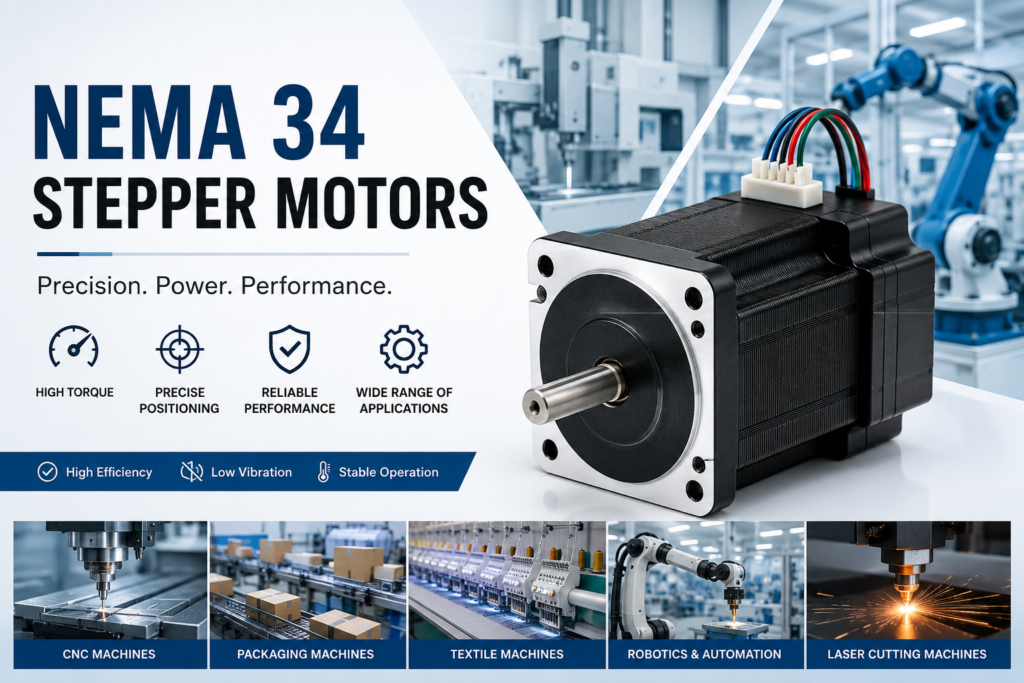
How NEMA 34 Stepper Motors Improve Industrial Automation
Industrial automation has transformed the way manufacturers operate, allowing businesses to increase productivity, improve precision, and reduce operational costs. As industries continue to embrace advanced technologies, the demand for reliable motion control systems has grown significantly. At the heart of many automated systems lies the stepper motor, a critical component responsible for delivering accurate and repeatable movement.
Stepper motors are widely used in industries ranging from manufacturing and packaging to robotics and medical equipment. Their ability to move in precise increments makes them an ideal solution for applications that require controlled positioning and speed regulation. Among the various types available, NEMA 34 stepper motors have emerged as a preferred choice for demanding industrial environments due to their power, durability, and performance capabilities.
This article explores how NEMA 34 stepper motors contribute to industrial automation, highlighting their features, advantages, applications, and role in improving efficiency across multiple industries.
Understanding Stepper Motors
A stepper motor is an electromechanical device that converts electrical pulses into precise mechanical movement. Unlike conventional motors that rotate continuously when powered, stepper motors move in discrete steps. Each electrical pulse corresponds to a specific rotational movement, enabling accurate control without requiring complex feedback systems.
Stepper motors are classified according to standardized frame sizes established by the National Electrical Manufacturers Association (NEMA). The NEMA designation primarily refers to the motor’s mounting dimensions rather than its performance specifications.
Why NEMA 34 Stepper Motors Are Popular
Among the many options available, NEMA 34 Stepper Motors have become a leading choice for industrial automation systems because of their high torque output, reliability, and ability to handle demanding workloads. These motors feature a larger frame size, typically measuring 3.4 inches by 3.4 inches, allowing them to generate significantly greater torque than smaller stepper motors.
Their robust construction enables them to perform consistently in industrial settings where precision and durability are essential. As automation systems become more advanced, the need for powerful motors capable of handling heavier loads continues to increase, making NEMA 34 stepper motors an indispensable component.
Key Features of NEMA 34 Stepper Motors
High Torque Output
One of the most significant advantages of NEMA 34 stepper motors is their exceptional torque generation. These motors can provide substantial holding and running torque, making them suitable for moving heavy loads and operating large mechanical systems.
High torque is particularly important in applications such as CNC machinery, automated conveyors, and industrial robotics, where precision movement must be maintained under varying load conditions.
Precise Positioning
Industrial automation relies heavily on accurate positioning. NEMA 34 stepper motors excel in this area by moving in fixed increments, allowing systems to achieve exact positioning without the need for expensive feedback mechanisms.
This precision ensures consistent product quality and reduces the risk of manufacturing errors.
Excellent Reliability
Industrial environments often expose equipment to continuous operation, vibrations, and harsh conditions. NEMA 34 stepper motors are designed to withstand these challenges while maintaining reliable performance over extended periods.
Their simple construction minimizes wear and tear, resulting in lower maintenance requirements and longer operational life.
Easy Integration
Modern automation systems require components that can be integrated seamlessly with controllers, drivers, and programmable logic controllers (PLCs). NEMA 34 stepper motors are compatible with a wide range of control systems, making implementation straightforward for engineers and manufacturers.
Cost-Effective Motion Control
Compared to servo motors, stepper motors often provide a more economical solution for applications that do not require closed-loop feedback. NEMA 34 motors deliver an excellent balance between performance and cost, helping businesses maximize return on investment.
The Role of NEMA 34 Stepper Motors in Industrial Automation
Automation systems depend on precise motion control to ensure efficient and repeatable operations. NEMA 34 stepper motors play a vital role in achieving these objectives across numerous industrial processes.
Enhancing Manufacturing Accuracy
Precision is critical in manufacturing environments where even minor deviations can lead to product defects. NEMA 34 stepper motors enable machinery to perform highly accurate movements, ensuring consistent production quality.
Whether drilling, cutting, assembling, or positioning components, these motors contribute significantly to maintaining tight tolerances throughout the production process.
Improving Production Efficiency
Automation aims to increase output while minimizing manual intervention. NEMA 34 stepper motors support this goal by delivering reliable and repeatable motion control that allows machinery to operate continuously with minimal downtime.
Their ability to maintain consistent performance improves production speed and overall operational efficiency.
Supporting Complex Automation Systems
Modern industrial facilities often employ sophisticated automated equipment involving multiple axes of movement. NEMA 34 stepper motors provide the torque and precision required to coordinate complex motion sequences accurately.
This capability is essential in applications such as robotic arms, automated assembly lines, and material handling systems.
Reducing Operational Costs
By enabling efficient automation, NEMA 34 stepper motors help reduce labor costs and minimize production errors. Their durability also lowers maintenance expenses, contributing to long-term cost savings for businesses.
Applications of NEMA 34 Stepper Motors
CNC Machines
Computer Numerical Control (CNC) machines require precise movement to produce accurate cuts and shapes. NEMA 34 stepper motors are widely used in CNC routers, mills, and plasma cutters because they provide the torque and positioning accuracy necessary for high-quality machining operations.
Industrial Robotics
Robotic systems rely on controlled movement to perform tasks such as assembly, welding, and packaging. NEMA 34 stepper motors offer the precision and reliability needed to execute these tasks efficiently and consistently.
Packaging Equipment
Packaging lines demand synchronized motion to maintain production speed and product consistency. NEMA 34 motors are frequently employed in labeling machines, filling systems, and conveyor equipment to ensure smooth operation.
Material Handling Systems
Automated warehouses and manufacturing facilities utilize conveyors, lifts, and sorting systems to transport materials efficiently. NEMA 34 stepper motors provide the power necessary to move heavy loads while maintaining precise positioning.
Textile Machinery
Textile production equipment requires accurate motion control for weaving, cutting, and fabric handling processes. NEMA 34 motors help ensure consistent product quality and efficient machine operation.
Medical Equipment
Certain medical devices depend on precise mechanical movement for diagnostics, laboratory automation, and imaging applications. NEMA 34 stepper motors deliver the accuracy required for these critical tasks.
Advantages Over Conventional Motors
Better Position Control
Unlike traditional induction motors, stepper motors can move to exact positions without requiring additional sensors or feedback systems. This simplifies system design and reduces complexity.
Superior Repeatability
Repeatability is essential in automation applications where the same motion must be performed repeatedly. NEMA 34 stepper motors provide highly consistent performance, ensuring reliable operation over countless cycles.
Instant Start and Stop Capability
Stepper motors can start, stop, and reverse direction quickly without requiring extensive acceleration or deceleration processes. This responsiveness improves productivity in fast-paced industrial environments.
Enhanced Low-Speed Performance
Many industrial applications require precise control at low speeds. NEMA 34 stepper motors maintain excellent torque characteristics at lower speeds, making them suitable for applications involving careful positioning.
Energy Efficiency and Sustainability
As industries focus increasingly on sustainability, energy-efficient technologies have become a priority. NEMA 34 stepper motors contribute to energy conservation by delivering motion only when needed. Their efficient operation reduces power consumption compared to less precise motor systems.
Energy savings not only lower operating costs but also support environmental initiatives aimed at reducing industrial carbon footprints.
Future Trends in Industrial Automation
The future of industrial automation is closely linked to advancements in motion control technology. Emerging trends such as Industry 4.0, smart factories, and the Industrial Internet of Things (IIoT) are driving demand for intelligent and highly efficient automation components.
NEMA 34 stepper motors are expected to remain an important part of this evolution. Enhanced driver technologies, improved control algorithms, and integrated monitoring capabilities will further increase their performance and reliability.
Manufacturers are also exploring hybrid systems that combine the advantages of stepper and servo technologies, creating even more versatile solutions for complex automation requirements.
Selecting the Right NEMA 34 Stepper Motor
Choosing the appropriate motor involves evaluating several factors, including:
- Required torque output
- Operating speed
- Load characteristics
- Environmental conditions
- Voltage and current requirements
- Control system compatibility
Proper motor selection ensures optimal performance and prevents issues such as overheating, missed steps, or reduced efficiency.
Working with experienced automation specialists can help businesses identify the most suitable motor configuration for their specific applications.
Maintenance Considerations
Although NEMA 34 stepper motors are known for their reliability, regular maintenance remains important for maximizing lifespan and performance.
Recommended maintenance practices include:
- Inspecting electrical connections
- Monitoring operating temperatures
- Cleaning dust and debris from motor surfaces
- Checking mounting hardware
- Verifying driver settings
Routine maintenance helps prevent unexpected failures and supports continuous operation in demanding industrial environments.
Conclusion
Industrial automation continues to revolutionize manufacturing and production processes, enabling businesses to achieve higher levels of efficiency, precision, and productivity. Motion control remains a critical aspect of automated systems, and NEMA 34 stepper motors have proven to be one of the most effective solutions available.
Their combination of high torque, accurate positioning, reliability, and cost-effectiveness makes them ideal for a wide range of industrial applications. From CNC machinery and robotics to packaging systems and material handling equipment, these motors play a vital role in ensuring smooth and efficient operations.
As automation technologies continue to advance, NEMA 34 stepper motors will remain a key component in modern industrial systems. Their ability to deliver precise, repeatable motion while supporting increased productivity makes them an invaluable asset for businesses seeking to stay competitive in an increasingly automated world.
About Post Author
