
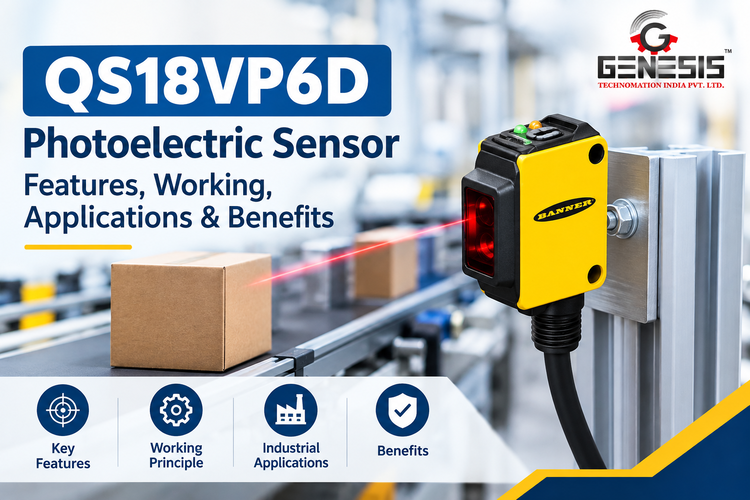
QS18VP6D Photoelectric Sensor: Detection Range, Response and Reliability
Photoelectric sensors are widely used in industrial automation because they provide fast, non-contact object detection and help machines operate with greater precision. From manufacturing lines and packaging equipment to material handling systems, these sensors play an important role in monitoring objects, controlling movements, and improving production efficiency. When selecting a sensor for an industrial application, factors such as detection range, response time, sensing performance, environmental resistance, and long-term reliability deserve careful attention.
A photoelectric sensor works by using light to identify the presence or absence of an object. Depending on its sensing configuration, it may detect objects through reflected light, interruption of a light beam, or reflection from a target. Unlike mechanical switches, photoelectric sensors do not require physical contact with the object being detected. This makes them useful in applications where speed, repeatability, and reduced mechanical wear are important.
The right sensor can make a significant difference in production performance. A sensor that detects objects consistently helps reduce unwanted machine stops, improves product positioning, supports automated counting, and makes processes more predictable. However, not every sensor performs equally in every environment. Target material, object size, distance, ambient lighting, dust, vibration, and installation conditions can all influence detection results.
For engineers, maintenance teams, machine builders, and automation professionals, understanding sensor specifications is more useful than simply choosing a component based on its appearance or price. A sensor should be selected according to the application requirements, the operating environment, and the electrical compatibility of the control system.
The QS18VP6D photoelectric sensor is designed for industrial object detection applications where dependable sensing, fast switching, and easy integration into automated equipment are important. It belongs to the Banner Engineering WORLD-BEAM QS18 sensor family and uses diffuse sensing technology to detect objects by measuring reflected infrared light. Its sensing range, response characteristics, and industrial design make it a practical option for various machine automation tasks.
What Is the QS18VP6D Photoelectric Sensor?
The QS18VP6D is a diffuse-mode photoelectric sensor used to detect the presence or absence of objects without physical contact. It contains an emitter and receiver within the same housing. The emitter sends infrared light toward the target, while the receiver detects the light reflected from the object’s surface.
When sufficient reflected light is received, the sensor changes its output state. This output can be connected to a programmable logic controller (PLC), relay interface, counter, or other compatible automation equipment.
The sensor is suitable for applications involving product detection, conveyor monitoring, packaging machinery, assembly equipment, and material handling systems. Its compact design allows it to be installed in different machine layouts without requiring excessive mounting space.
The QS18VP6D is particularly useful when engineers need a straightforward sensing solution that can detect objects at a moderate distance and provide a switching signal to a control system.
QS18VP6D Technical Specifications
Understanding the specifications is essential before selecting a sensor for a machine or production line. The following are the commonly listed technical characteristics of the QS18VP6D model.
- Sensor series: WORLD-BEAM QS18
- Sensing technology: Diffuse photoelectric
- Light source: Infrared LED
- Infrared wavelength: 940 nm
- Maximum sensing range: 450 mm
- Operating voltage: 10–30 V DC
- Output type: PNP
- Output configuration: Complementary NO/NC
- Response time: Approximately 0.6 ms
- Power-up delay: Approximately 100 ms
- Protection rating: IP67
- Operating temperature: -20°C to +70°C
- Connection: Four-wire cable
- Cable length: 2 metres
- Housing material: ABS plastic
- Lens material: Acrylic
- Sensitivity adjustment: Potentiometer
These specifications help determine whether the sensor is suitable for a particular machine. However, actual detection performance can vary depending on the target material, installation distance, operating environment, and configuration.
Understanding the 450 mm Detection Range
One of the important features of the QS18VP6D is its maximum sensing range of 450 mm, which is approximately 18 inches. This allows the sensor to detect objects from a distance without requiring direct contact or extremely close mounting.
For machine designers, this detection range can provide more flexibility when positioning sensors around conveyors, production equipment, and automated workstations. The sensor may be mounted away from moving components while still detecting the target within its specified operating range.
However, the maximum sensing distance should not be treated as a guaranteed distance for every object. Diffuse sensors depend on reflected light, so the detection range can change according to the target’s surface characteristics.
How Diffuse Sensing Technology Works
Diffuse sensing uses the reflection of light from an object to determine whether it is present. The sensor’s emitter sends infrared light toward the target. When the light reaches an object, a portion of it is reflected back toward the receiver.
If the returning light reaches the required signal level, the sensor identifies the target and changes its output state. When the object moves away or the reflected signal falls below the detection threshold, the sensor switches back.
This arrangement is convenient because the emitter and receiver are located in the same housing. Unlike through-beam sensors, diffuse sensors generally do not require a separate receiver installed on the opposite side of the detection area.
Factors That Affect Detection Range
The detection range of a diffuse photoelectric sensor can be influenced by several factors.
Target colour: Light-coloured objects often reflect more infrared light than dark-coloured objects. A white target may be easier to detect at a longer distance than a black or dark rubber surface.
Surface finish: Smooth, rough, glossy, matte, and textured surfaces can reflect infrared light differently. A highly reflective surface may produce an inconsistent signal depending on its orientation.
Target size: Larger objects generally provide a greater reflective surface area. Small objects may require closer installation or more careful sensitivity adjustment.
Target angle: If the target is positioned at an angle, reflected light may travel away from the sensor’s receiver. Correct positioning helps improve detection consistency.
Environmental contamination: Dust, dirt, oil, and moisture on the lens may reduce the amount of light transmitted and received. Regular cleaning helps maintain sensing performance.
Background conditions: Objects or machine surfaces located behind the intended target may also reflect light. Adjusting sensitivity and positioning the sensor carefully can help prevent false detection.
For best results, engineers should test the sensor using the actual target material and operating conditions. Installing the sensor slightly closer than its maximum rated sensing distance may also provide better detection margin.
Response Time and Switching Performance
Response time is an important specification for applications involving moving products, high-speed conveyors, automatic counting, and machine sequencing. The QS18VP6D has a listed response time of approximately 0.6 milliseconds, which allows it to react quickly when the target enters or leaves the sensing area.
A fast response helps reduce the possibility of missing moving objects. It can also improve the timing of automated processes where a detection signal is used to trigger another machine operation.
Why Response Time Matters
Consider a conveyor transporting packages at a consistent speed. The photoelectric sensor detects each package and sends a signal to the PLC. The PLC may use that signal to count products, activate a diverter, control a label applicator, or initiate another process.
If the sensor response is too slow for the conveyor speed and object spacing, detection may become inconsistent. Products could be missed, counted incorrectly, or detected too late for the required machine operation.
Fast switching performance is therefore important in applications such as:
- Product counting on conveyors
- Package detection in packaging machines
- Part presence monitoring during assembly
- Automatic sorting and classification
- Position detection in production equipment
- Triggering pneumatic or mechanical operations
- Monitoring product movement between machine stations
The sensor response time is only one part of the complete system. PLC scan time, input filtering, output processing, communication delays, and mechanical response can also affect the final result.
Response Time and Switching Frequency
Response time describes how quickly a sensor reacts to a change in detection conditions. Switching frequency describes how often the sensor can switch under specified operating conditions.
Both specifications are important for high-speed automation. When objects move quickly or are positioned close together, engineers should evaluate the sensor along with conveyor speed, object size, spacing, and PLC input settings.
Testing the sensor with the actual machine operating conditions is the best way to confirm that it can provide consistent switching performance.
Detection Reliability in Industrial Environments
Industrial reliability means more than detecting an object during a single test. A sensor should continue performing consistently during normal machine operation, even when exposed to vibration, dust, temperature changes, and other environmental conditions.
The QS18VP6D is designed for industrial use and features an IP67 protection rating. This rating provides protection against dust ingress and temporary immersion under defined testing conditions. It makes the sensor suitable for many industrial environments where occasional exposure to dust, moisture, or splashing may occur.
Protection Against Dust and Moisture
Dust and dirt can accumulate on the sensor’s optical surface over time. In manufacturing plants, warehouses, packaging areas, and material handling facilities, contamination may reduce the amount of infrared light reaching the target and returning to the receiver.
Although the IP67-rated housing provides environmental protection, the sensing lens should still be inspected periodically. Cleaning the optical surface when necessary can help prevent detection problems and maintain reliable operation.
The IP67 rating should not automatically be interpreted as suitability for every washdown application. Installation conditions, chemicals, cleaning pressure, temperature, and exposure duration should be considered before using the sensor in demanding cleaning environments.
Operating Temperature
The listed operating temperature range is -20°C to +70°C, which supports use in many indoor industrial applications and selected demanding environments.
Temperature should be checked around the actual mounting position. Machinery, motors, heaters, enclosed equipment, and direct sunlight may create temperatures that differ from the surrounding room.
Operating the sensor within its specified temperature range helps maintain stable performance and reduces the risk of premature failure.
Mechanical Stability and Vibration
Industrial equipment may experience vibration from motors, conveyors, pneumatic systems, and moving machinery. If the sensor mounting position changes, its detection area may shift and affect sensing performance.
Secure mounting, suitable brackets, locking hardware, and proper cable routing can help prevent unwanted movement. A sensor should be positioned so that it remains stable during normal machine operation.
Output Configuration and Electrical Compatibility
The QS18VP6D uses a PNP output configuration with complementary switching functionality. This allows it to provide switching signals suitable for compatible PLC inputs and industrial control systems.
PNP sensors are commonly used in automation applications where the control input is designed to receive a positive voltage signal. When the sensor output switches on, it supplies a positive signal to the connected input circuit.
Before connecting the sensor, confirm that the PLC input type, supply voltage, load requirements, and wiring configuration are compatible.
Supply Voltage
The sensor operates within a 10–30 V DC supply range, which is commonly used in industrial control systems. This voltage range provides flexibility for installations using standard DC power supplies.
A stable power supply is important for consistent sensor performance. Voltage drops, loose connections, electrical noise, and incorrect wiring may lead to unreliable operation.
Output Compatibility
When selecting a photoelectric sensor, engineers should verify the output type and switching arrangement. The PNP output must be compatible with the connected PLC input or control circuit.
Correct wiring is essential. Incorrect connections may prevent the sensor from operating properly or may damage the sensor and connected equipment.
Always refer to the wiring diagram supplied with the exact model before installation.
Applications of the QS18VP6D Photoelectric Sensor
The QS18VP6D can be used in several industrial automation applications where non-contact detection is required.
Conveyor Systems
Conveyors are among the most common applications for photoelectric sensors. The sensor can detect products moving along a conveyor and provide signals for counting, tracking, sorting, or controlling downstream processes.
Its diffuse sensing arrangement can be useful where installing a separate emitter and receiver across the conveyor is not practical.
Packaging Machinery
Packaging equipment often requires accurate detection of cartons, bottles, containers, wrappers, and other products. A photoelectric sensor can help confirm product presence before packaging, sealing, labeling, or filling operations begin.
Reliable detection helps reduce packaging errors and improves process coordination.
Assembly Lines
During automated assembly, sensors may be used to confirm that components are present before the next operation starts. The QS18VP6D can provide a detection signal for parts moving through assembly stations or positioned on fixtures.
This can help prevent incomplete operations and support more consistent production quality.
Material Handling
Material handling systems require dependable monitoring of items moving between stations. Photoelectric sensors can detect objects entering or leaving a specific area, helping control automated transfers and machine sequences.
Product Counting
In counting applications, the sensor detects each object passing through the sensing area. The output signal can be connected to a PLC counter or another compatible counting system.
For reliable counting, the target size, conveyor speed, object spacing, mounting distance, and control-system response should all be considered.
Installation Best Practices
Correct installation plays a major role in sensor reliability. Even a sensor with suitable specifications may perform poorly if it is incorrectly positioned or adjusted.
Choose the Right Mounting Position
Install the sensor where it can detect the target consistently without interference from nearby objects. Avoid positions where machine structures, reflective surfaces, or moving components may cause unwanted detection.
Adjust Sensitivity Carefully
The sensitivity adjustment should be configured according to the target and background conditions. Excessive sensitivity may cause the sensor to detect unwanted objects, while insufficient sensitivity may result in missed detection.
Adjust the sensor while observing the actual target and background to establish a stable operating point.
Maintain Proper Alignment
Position the sensor so that its sensing direction is appropriate for the target surface. Avoid extreme angles that may reduce the amount of reflected light reaching the receiver.
Protect the Cable
Cable routing should prevent unnecessary tension, sharp bends, abrasion, and exposure to moving components. Proper cable management reduces the possibility of intermittent electrical connections.
Test Under Real Operating Conditions
After installation, test the sensor while the machine is operating at its normal speed. Confirm that it detects the target consistently, switches correctly, and does not respond to unwanted background objects.
Troubleshooting Common Detection Problems
Even when correctly selected, photoelectric sensors may experience detection issues because of installation or environmental conditions.
Sensor does not detect the target: Check the supply voltage, wiring, sensitivity adjustment, target distance, and target reflectivity. The object may be outside the effective sensing range.
Sensor detects the background: Reduce sensitivity if appropriate, reposition the sensor, or change the detection angle to reduce background reflection.
Intermittent detection: Inspect the sensor mounting, cable connections, lens condition, target movement, and electrical noise. Small changes in target position may also affect detection.
False triggering: Nearby reflective surfaces, ambient lighting conditions, vibration, or excessive sensitivity may cause unwanted switching. Adjust the sensor position and sensitivity and verify the operating conditions.
Output does not change: Check the wiring configuration, PLC input compatibility, supply voltage, and sensor settings. Verify that the target is actually entering the sensing area.
A systematic troubleshooting approach can help maintenance teams identify the root cause without unnecessarily replacing working equipment.
Maintenance and Long-Term Reliability
Photoelectric sensors generally require less mechanical maintenance than contact-based switches because they detect objects without physical contact. Nevertheless, periodic inspection is important in industrial environments.
Maintenance teams should check the sensor lens for dust, dirt, oil, or other contamination. The mounting arrangement should be inspected for looseness, vibration, and alignment changes. Cable connections should also be checked for damage or wear.
Where the sensor operates in a dusty environment, cleaning frequency may need to be increased. Preventive maintenance schedules should reflect the actual operating conditions rather than relying on a fixed interval for every machine.
Keeping a record of sensor-related faults, detection issues, and maintenance activities can help identify recurring problems and improve machine reliability over time.
Benefits of Using the QS18VP6D
The QS18VP6D offers several practical advantages for industrial automation applications.
- Non-contact object detection
- Diffuse sensing with integrated emitter and receiver
- Maximum sensing range of up to 450 mm
- Fast response time for moving objects
- PNP output compatibility with suitable industrial control systems
- Compact housing for machine installation
- IP67 protection rating
- Adjustable sensitivity
- Suitable for product detection, counting, and monitoring applications
- Reduced mechanical wear compared with contact-based detection methods
These benefits can support more efficient production processes when the sensor is correctly selected, installed, and maintained.
Conclusion
The QS18VP6D photoelectric sensor is a practical sensing solution for industrial automation applications that require reliable object detection, fast switching, and non-contact operation. Its diffuse sensing technology, maximum detection range of 450 mm, response time of approximately 0.6 ms, PNP output, and IP67 protection rating make it suitable for a variety of manufacturing, packaging, conveyor, assembly, and material handling applications.
However, the sensor’s performance depends on more than its technical specifications. Target reflectivity, object size, mounting distance, sensitivity adjustment, environmental contamination, electrical compatibility, and machine operating speed all influence detection reliability.
By selecting the correct installation position, maintaining the optical surface, verifying wiring, and testing the sensor under real operating conditions, engineers and maintenance teams can achieve more consistent detection and reduce avoidable machine interruptions.
For applications where dependable object sensing is an important part of production control, understanding the detection range, response performance, and reliability characteristics of the QS18VP6D helps make a more informed automation equipment decision.
About Post Author
