
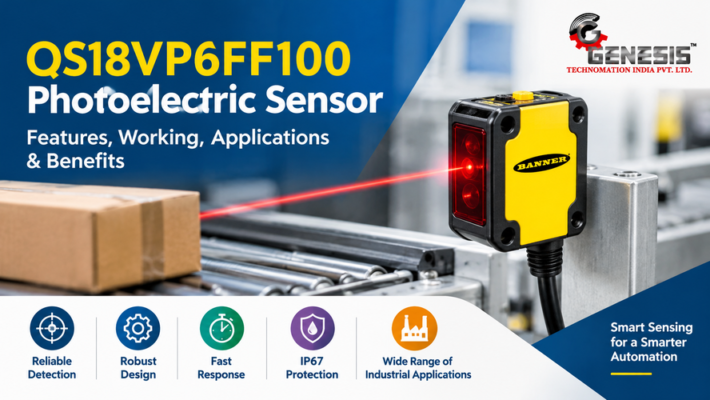
QS18VP6FF100 Photoelectric Sensor: Features and Applications
Photoelectric sensors play an important role in modern industrial automation. They help machines detect objects, monitor production activities, control material movement, and improve operational efficiency without requiring physical contact. These sensors use light to identify the presence or absence of objects, making them suitable for manufacturing plants, packaging facilities, conveyor systems, and other automated environments.
In industries where speed, accuracy, and consistent performance are essential, selecting the right photoelectric sensor can make a significant difference. A suitable sensor can reduce manual inspection, minimize production errors, and help automated equipment operate more reliably. Different sensing technologies are available to address specific requirements, including diffuse, retroreflective, opposed-mode, and background-suppression sensing.
One important category is fixed-field photoelectric sensing. This technology helps detect objects within a defined sensing distance while reducing unwanted responses from backgrounds located beyond the sensor’s cutoff point. It is particularly useful when products move along conveyors or pass through automated inspection stations.
The Banner Engineering WORLD-BEAM QS18 series includes compact photoelectric sensors designed for a variety of industrial applications. These sensors combine practical mounting options, visible status indicators, and different sensing configurations to support automation requirements. The QS18 family offers models with different sensing ranges and output configurations.
The QS18VP6FF100 is a fixed-field photoelectric sensor designed for proximity detection with a maximum sensing distance of 100 mm. It uses visible red LED light and background suppression technology to identify objects within its specified detection range. With a complementary PNP solid-state output, a 10–30 V DC operating supply, and a 2-meter cable, this model is designed for integration into compatible industrial control systems.
Understanding its operating principle, technical specifications, features, and practical applications can help engineers, maintenance professionals, and automation specialists determine whether this sensor is appropriate for their equipment.
What Is the QS18VP6FF100 Photoelectric Sensor?
The QS18VP6FF100 is part of the WORLD-BEAM QS18 family manufactured by Banner Engineering. It is a compact, self-contained photoelectric sensor that uses fixed-field background suppression to detect objects within a predetermined sensing range.
Unlike conventional diffuse photoelectric sensors, which can respond to reflected light from objects behind the target, fixed-field sensors are designed to distinguish objects within their detection zone from backgrounds beyond the cutoff point. This makes them useful in applications where the target and background are relatively close to each other.
The sensor operates using a visible red LED with a wavelength of 630 nm. Its maximum specified sensing distance is 100 mm (approximately 4 inches). The fixed-field design does not require a user-adjustable sensitivity setting, making it a practical option for applications that need a predefined detection distance.
The model also features complementary PNP solid-state outputs, allowing compatible industrial controllers to receive switching signals when an object is detected or removed. Its compact construction and cable-based connection make it suitable for integration into different machine designs.
Key Features of the QS18VP6FF100
The sensor combines several technical characteristics that support reliable object detection in industrial environments. Understanding these features helps determine where it can deliver the most value.
1. Fixed-Field Background Suppression
One of the most important features is its fixed-field background suppression technology.
This sensing method uses an emitter and multiple receiver elements to evaluate the reflected light coming from an object. The sensor’s internal electronics determine whether the detected object is within the defined sensing range.
The fixed cutoff helps distinguish the intended target from objects or surfaces located beyond the detection zone. This can reduce false switching caused by background surfaces in applications where the distance between the sensor and the target remains relatively consistent.
For example, when products move along a conveyor belt, the sensor can detect an item passing through its sensing area without necessarily responding to the belt or a background surface farther away.
2. 100 mm Sensing Distance
The QS18VP6FF100 offers a maximum sensing distance of 100 mm. This makes it appropriate for short-range proximity detection in automated equipment.
A 100 mm sensing range can support applications such as:
- Detecting products moving along conveyor belts.
- Monitoring the presence of components during assembly.
- Identifying packages at sorting stations.
- Detecting objects before automated processing.
- Monitoring material movement in production equipment.
The fixed sensing distance also helps simplify machine configuration because the application can be designed around a predefined detection point.
It is important to remember that 100 mm is the specified maximum range, not a guarantee that every target material will be detected identically under all conditions.
3. Visible Red LED Light Source
The sensor uses a visible red LED with a wavelength of 630 nm.
A visible sensing beam can make installation and alignment easier because technicians can identify the approximate sensing direction without relying entirely on specialized optical instruments.
This is particularly useful when positioning sensors near conveyor belts, production lines, and assembly stations.
The visible light source also supports straightforward troubleshooting. Maintenance personnel can inspect the sensor’s alignment and check whether the sensing area is positioned correctly.
4. Complementary PNP Output
The QS18VP6FF100 uses a complementary solid-state PNP output configuration.
PNP sensors are commonly used with industrial control systems that accept sourcing-type inputs. When the sensor detects a target, the switching output supplies a positive voltage signal to the connected control input, according to the selected operating mode.
The complementary output configuration provides light-operate and dark-operate switching options.
This flexibility allows engineers to configure the sensor according to the application’s control requirements.
Before installation, it is important to verify that the PLC input configuration is compatible with PNP outputs and that the electrical load remains within the manufacturer’s specified limits.
5. Compact and Practical Housing
The QS18 family is designed with a compact housing to support different mounting arrangements.
The sensor uses an ABS plastic housing and an acrylic lens. Its M18 threaded mounting arrangement helps simplify installation in compatible machine fixtures.
A compact sensor can be especially useful when equipment has limited installation space or several detection points need to be positioned close together.
The housing design also supports retrofitting applications where an existing machine requires a replacement or additional sensing component.
6. IP67 Protection Rating
The sensor carries an IP67 protection rating.
This rating indicates that the enclosure provides protection against dust ingress and temporary immersion in water under the specified test conditions.
It is useful in industrial environments where airborne dust, occasional splashing, and general manufacturing contamination may be present.
However, IP67 should not be confused with a guarantee of suitability for high-pressure washdown, aggressive cleaning chemicals, or continuous immersion. Those conditions require additional evaluation.
7. Fast Response Time
Response time is another important consideration when selecting a photoelectric sensor for automated equipment.
The QS18VP6FF100 has a typical output response time of approximately 0.85 milliseconds.
Fast switching helps the sensor detect moving products without introducing unnecessary delays into the machine’s control sequence.
For example, a conveyor system can use the sensor to identify passing packages and send signals to a PLC for subsequent operations.
The sensor also provides repeatable switching performance, with the specified repeatability being 90 microseconds.
8. Wide Operating Temperature Range
The sensor is designed to operate within a temperature range of -20°C to +70°C.
This operating range supports its use in different industrial environments, including indoor manufacturing facilities and equipment exposed to changing ambient temperatures.
The specified maximum relative humidity is 95% at +50°C, non-condensing.
These environmental specifications should be considered when installing the sensor near heating equipment, production machinery, or areas where temperature and humidity fluctuate.
Technical Specifications of QS18VP6FF100
The following table summarizes the important specifications of this photoelectric sensor.
| Specification | Details |
| Manufacturer | Banner Engineering |
| Product Series | WORLD-BEAM QS18 |
| Model | QS18VP6FF100 |
| Sensor Type | Photoelectric sensor |
| Sensing Mode | Fixed-field |
| Detection Principle | Background suppression |
| Maximum Sensing Distance | 100 mm |
| Light Source | Visible red LED |
| Wavelength | 630 nm |
| Operating Voltage | 10–30 V DC |
| Output Type | Complementary PNP |
| Output Configuration | Light-operate / Dark-operate |
| Maximum Output Current | 100 mA per output |
| Response Time | 0.85 ms |
| Repeatability | 90 µs |
| Connection Type | 4-wire cable |
| Cable Length | 2 meters |
| Housing Material | ABS plastic |
| Lens Material | Acrylic |
| Protection Rating | IP67 |
| Operating Temperature | -20°C to +70°C |
| Adjustment | Fixed-field, non-adjustable |
| Mounting | M18 threaded mounting arrangement |
How Does the QS18VP6FF100 Work?
Understanding the operating principle of a photoelectric sensor helps engineers select the right device for their automation requirements.
The QS18VP6FF100 works through a light-emission and reflection process. It sends visible red light toward the target area and evaluates the amount and distribution of reflected light received by its internal optical elements.
Its operating process can be explained in the following steps.
Step 1: Light emission
The sensor’s internal LED emits visible red light toward the detection area. This light travels through the sensor’s optical system and reaches the target surface.
Step 2: Light reflection
When an object enters the sensing area, some of the emitted light reflects from its surface and travels back toward the sensor.
Step 3: Optical evaluation
The receiver elements detect the reflected light. The internal electronics evaluate the received light distribution to determine whether the object is positioned within the sensor’s fixed detection field.
Step 4: Output switching
When the object meets the sensor’s detection criteria, the PNP output changes its switching state. The connected PLC or machine controller receives the signal and can initiate the programmed operation.
Step 5: Object removal
When the object leaves the sensing field, the sensor changes its output state according to the selected light-operate or dark-operate configuration.
This process allows automated equipment to identify object presence without requiring direct contact.
Industrial Applications of the QS18VP6FF100
The QS18VP6FF100 can support different industrial automation tasks where short-range object detection and consistent switching are required. Its fixed-field sensing technology makes it particularly useful for applications involving defined product positions.
Here are some common applications.
1. Conveyor Belt Systems
Conveyor systems are widely used in manufacturing, warehousing, packaging, and distribution facilities. Photoelectric sensors help monitor products as they travel between different production stages.
The QS18VP6FF100 can be installed beside or above a conveyor to detect products passing through its sensing zone.
When an item enters the detection area, the sensor sends a switching signal to the connected controller. This signal can be used to activate counting systems, control conveyor sections, or initiate other automated processes.
Its fixed-field detection capability can also help reduce unwanted switching from backgrounds positioned beyond the cutoff point.
2. Packaging and Filling Machines
Packaging equipment requires accurate object detection to maintain consistent production operations.
The sensor can be used to identify the presence of containers, packages, cartons, and other products at predefined machine positions.
For example, a packaging machine may use a photoelectric sensor to confirm that a container has reached a particular position before the filling or sealing process begins.
The fast response time supports applications where products move continuously through automated packaging stations.
3. Manufacturing and Assembly Lines
Assembly lines involve multiple operations that must happen in a specific sequence. Detecting whether a component is present at the correct location is essential for maintaining production accuracy.
The QS18VP6FF100 can help identify components positioned on fixtures, conveyor sections, or assembly platforms.
When a component reaches the detection point, the sensor sends a signal to the machine controller. The controller can then allow the next production step to proceed.
This type of detection can help reduce errors caused by missing components or incorrect positioning.
4. Automated Sorting Systems
Automated sorting systems use different sensors to monitor products and coordinate material movement.
A fixed-field photoelectric sensor can detect packages as they pass through a specific detection point.
The resulting signal can be used by a PLC to coordinate sorting operations, activate downstream equipment, or monitor the movement of products through a processing station.
The 100 mm sensing range makes this model more suitable for relatively close detection points rather than long-distance package detection.
5. Material Handling Equipment
Material handling equipment requires reliable sensing to monitor the movement of raw materials, components, and finished products.
The QS18VP6FF100 can be integrated into compatible handling systems to identify whether an object has reached a particular position.
For instance, it can detect the presence of a component before a mechanical transfer mechanism begins moving it to another station.
This helps coordinate automated machine operations and reduces the need for manual monitoring.
6. Component Presence Detection
Manufacturing equipment often needs to confirm whether a component is available before beginning an operation.
The sensor can be positioned near a component holder, assembly fixture, or machine station to detect the presence of an object within its sensing range.
This can be useful in electronics manufacturing, automotive component assembly, and general industrial production.
However, detection suitability should be tested with the actual component because surface reflectivity, dimensions, and positioning can influence optical performance.
7. Automated Machine Monitoring
Automated machinery frequently uses photoelectric sensors to monitor different operating stages.
The QS18VP6FF100 can provide object-presence signals to compatible controllers, helping machines identify whether products or components have reached designated positions.
Its compact housing also makes it practical for installations where available mounting space is limited.
Installation and Wiring Considerations
Correct installation is essential for obtaining consistent sensing performance. Even a technically suitable sensor may produce unreliable results if it is incorrectly positioned or connected.
The following considerations can help during installation.
1. Select the Correct Mounting Position
Install the sensor so that its sensing face points toward the intended target area.
Maintain an appropriate distance between the sensor and the object, considering its maximum 100 mm sensing range.
The mounting position should also prevent unnecessary interference from surrounding machine components.
2. Secure the Sensor Properly
Use a compatible mounting arrangement to secure the sensor.
Ensure that the sensor does not move due to machine vibration or mechanical impact. Changes in mounting position can affect detection reliability.
3. Check Electrical Compatibility
The sensor operates on a 10–30 V DC supply.
Before connecting it to a PLC or other control equipment, verify the supply voltage, input configuration, and electrical load requirements.
The complementary PNP output must be compatible with the connected controller.
4. Verify the Wiring
The model uses a four-wire, 2-meter cable. The wiring configuration should be checked against the manufacturer’s model-specific wiring diagram.
The standard wire functions are:
| Wire Color | Function |
| Brown | Positive supply |
| Blue | Negative supply |
| Black | Normally open output |
| White | Complementary output |
Confirm the actual terminal and output functions using the manufacturer’s wiring diagram before connecting the sensor.
Electrical connections should be completed by qualified personnel following applicable electrical codes.
5. Test Detection Performance
After installation, test the sensor using the actual target materials.
Check that the sensor detects products at the required position and does not respond incorrectly to nearby background surfaces.
Testing should include different product sizes, positions, and surface finishes expected during normal operation.
Advantages of Using the QS18VP6FF100
The sensor offers several practical advantages for compatible industrial applications.
- Non-contact detection: Identifies objects without requiring physical contact.
- Background suppression: Helps distinguish targets from backgrounds beyond the fixed sensing range.
- Fast response: Its approximately 0.85 ms response time supports quick switching operations.
- Compact construction: Fits into installations where mounting space is limited.
- Visible sensing light: Simplifies alignment and installation.
- PNP output: Supports integration with compatible industrial controllers.
- IP67 protection: Provides protection against dust and temporary water immersion.
- Wide voltage compatibility: Operates with a 10–30 V DC supply.
- Low maintenance requirements: Does not require mechanical contact with the target during normal sensing.
Limitations and Important Considerations
Although the QS18VP6FF100 offers several useful features, it is not suitable for every industrial sensing requirement.
Before selecting this model, consider the following limitations.
Fixed sensing distance: Its detection range is predefined. Applications requiring frequent changes to the sensing distance may need an adjustable sensor.
Short detection range: The maximum sensing distance is 100 mm. It is not designed for long-range object detection.
Transparent object detection: This model is not specifically designed for reliable detection of clear objects. Dedicated clear-object sensing technology may be necessary.
Surface characteristics: Object color, reflectivity, size, and orientation can influence sensing performance. Always test the actual target.
Electrical compatibility: Its PNP output must match the connected control system.
Environmental suitability: Although IP67 protection is provided, the model should not automatically be considered suitable for aggressive chemical exposure or high-pressure washdown.
Not a safety device: This sensor must not be used as the primary personnel protection device for hazardous machinery. Appropriate safety-rated equipment is required for personnel protection.
QS18VP6FF100 vs. Other QS18 Sensor Models
The WORLD-BEAM QS18 series includes different sensing configurations designed for specific industrial requirements.
The following comparison highlights some related models.
| Model | Sensing Mode | Range | Output |
| QS18VP6FF50 | Fixed-field | 50 mm | PNP |
| QS18VP6FF100 | Fixed-field | 100 mm | PNP |
| QS18VP6FF125 | Fixed-field | 125 mm | PNP |
| QS18VP6FF150 | Fixed-field | 150 mm | PNP |
| QS18VP6W | Divergent diffuse | 100 mm | PNP |
| QS18VP6D | Diffuse | 450 mm | PNP |
The main difference between these models is their sensing configuration and detection range.
For applications requiring fixed-field background suppression at a distance of up to 100 mm, the QS18VP6FF100 is one option to consider.
If an application requires a different detection distance or sensing method, another QS18 model may be more appropriate.
Maintenance Tips for Better Performance
Regular inspection can help maintain reliable sensor operation and reduce unexpected production interruptions.
Consider these maintenance practices:
- Clean the optical surface: Remove dust and dirt from the sensor lens using the manufacturer’s recommended cleaning procedure.
- Inspect cable connections: Check the cable for damage, loose connections, and excessive bending.
- Verify mounting stability: Ensure that the sensor remains securely positioned.
- Check status indicators: Use the available LED indicators to help identify power and sensing conditions.
- Test detection accuracy: Periodically verify that the sensor detects the intended objects correctly.
- Inspect the operating environment: Check for excessive contamination, moisture, vibration, or other conditions that could affect performance.
Regular maintenance helps identify potential issues before they affect production operations.
Where to Find the QS18VP6FF100 Datasheet and Product Information
Before purchasing or installing an industrial sensor, reviewing its technical specifications and product documentation is recommended.
The manufacturer’s documentation can help engineers understand the sensor’s operating characteristics, wiring requirements, mounting arrangements, and environmental limitations.
When evaluating the QS18VP6FF100, pay particular attention to:
- Operating voltage and current requirements.
- Fixed-field sensing distance.
- PNP output compatibility.
- Response time and repeatability.
- Housing and protection ratings.
- Operating temperature range.
- Cable and mounting requirements.
Reviewing these specifications before installation can help avoid compatibility problems and support reliable equipment operation.
Conclusion
The Banner Engineering QS18VP6FF100 is a compact fixed-field photoelectric sensor designed for short-range object detection in industrial automation applications. Its 100 mm sensing distance, visible red LED, complementary PNP output, fast response time, and IP67 protection make it a practical option for compatible manufacturing and material handling environments.
Its background suppression technology is particularly useful when detecting objects against nearby background surfaces. Applications such as conveyor monitoring, packaging machinery, component presence detection, automated sorting, and assembly operations can benefit from this sensing capability.
However, selecting the right sensor requires more than comparing detection distances. Engineers should also consider target characteristics, mounting arrangements, electrical compatibility, and environmental conditions.
By reviewing the technical specifications and testing the sensor under actual operating conditions, businesses can determine whether the QS18VP6FF100 meets their automation requirements and supports reliable machine operation.
About Post Author
